The Minutia Laffite

The Pirates Laffite: The Treacherous World of the Corsairs of the GulfThe Pirates Laffite: The Treacherous World of the Corsairs of the Gulf by William C. Davis
My rating: 3 of 5 stars

It took me three years to read this book. This was not a series of attempts, starting over again and again, having forgotten what I read before, but a single attempt, in which I laid the book down for months at a time and, taking it up again, resumed where I had left off.

This book was extraordinarily detailed. With those familiar with my progress in the book, I have joked that I would have found less information had I read the primary sources myself. Mr. Davis put such great effort into researching this subject, and presenting the truthful information he found, that I found it very easy to become bogged down in the minutia. The book also had a tendency to follow rabbit-trails, pursuing avenues of historical data that seemed largely irrelevant to the story of the Laffites.

On that account, the book became most exciting near the end, when documents became scarce and historical accuracy fell away, in favor of a few spare reports and a host of romantic fiction. While the details of tangentially related admiralty courts and Mexican independence movements had some bearing on the story of the Laffites, the real character of the brothers–and the adventures of their lives–seemed an afterthought. The relation of their deaths, in the next-to-last chapter, occurred mid-paragraph without any fanfare. The final chapter focused, in part, on the death of piracy in the Gulf; the remainder was about race relations in Louisiana, where Pierre Laffite’s descendants sought to deny non-white ancestry and forgot about the infamous brothers (except that they were pirates).

The summation of the brothers’ lives was both telling and, in a way, disappointing. The pirates Laffite were so careless with their money, so self-interested, and so unsuccessful (in spite of their many talents) that, according to the author, they had almost no bearing on the politics of the Gulf and, ultimately, died in poverty and failure. On the one hand, this is a reasonable warning against a life of self-interest and piracy, but on the other, it begs the question of why I should have spent three years reading about these men. (The real answer, of course, is that I should have buckled down and read through the book in a sensible amount of time, but I digress.)

If your interest in the corsairs of the Gulf is that of an academic historian, seeking more details on the politics, economics, and complexities of life in the early 19th century, then this may very well be your favorite book. For me, I appreciated the look at the realities of the last age of piracy, and I found much of the book informative, and even entertaining, there was far too much detail to keep me engaged as a reader. (Perhaps you will say that I should read a romanticized fiction of piracy that focuses on tall tales rather than real history, and perhaps you would be right, but I’m still glad to have read this book–I only wish it hadn’t taken so long.)

View all my reviews

An Acceptable Addition

The Sable Quean (Redwall, #21)The Sable Quean by Brian Jacques
My rating: 3 of 5 stars

This book didn’t really take me almost three years to read. I read a couple chapters, then reread them, then finally read the book all the way through.

I had a little trouble getting into the book initially, which is uncommon for Jacques’ books (in my experience). Most of his books have great hooks, great characters, and great adventure, right from the start. The problem with this one is that it did not quite feel original enough. The Ravagers remind me of the Rapscallions. Vilaya reminds me of Tsarmina or Silth the Marlfox. Zwilt reminds me of Ferahgo. Buckler is like a cross between Rakkety Tam and Tammo. Diggs is similar to any number of hares. The troupe of hedgehogs is like the Wandering Noonvale Companions or the Rambling Rosehip Players. Stealing children to defeat Redwall is like Mattimeo.

Ultimately, there were original elements. A warrior mole was a nice touch. Sables, as creatures, had not appeared before. I just had to work harder to find them than I usually do.

This book also seemed a little more tame than others, as far as deaths for heroes are concerned. Only one (named) protagonist character was killed in the course of the book. (Of course, a couple of my favorite books are probably Martin the Warrior and The Long Patrol, so I may be biased toward killing protagonists more than most fans.)

Ultimately, it was a fine installment, but not one of the best.

Of course, I’ve only just learned that Mr. Jacques passed away three years ago, so now I feel a little bad for saying negative things.

View all my reviews

Stay Tuned for the Stunning Conclusion!

Spoilers follow!
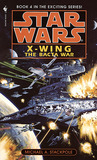
The Bacta War (Star Wars: X-Wing, #4)The Bacta War by Michael A. Stackpole
My rating: 4 of 5 stars

To be honest, I thought that, of all of the X-Wing novels, this one would survive my criticisms best. I recall it being my favorite, back in the day, and I could remember nothing against it.

Unfortunately, upon reading it, I did find a few things to take issue with. For one thing, all of the innuendo and nudge, nudge, wink, wink that went on in the preceding three books was consummated in this one. There was nothing explicit, of course, but innuendo was dropped in favor of stating things outright, and seduction gave way to indulgence. I get the impression that we’re supposed to celebrate these events, because most (or all? I don’t quite recall) of them are between Corran and Mirax, but it ends up seeming hollow. Perhaps the most damning of all, from my perspective, was when Mirax insisted on the “practice makes perfect” argument for sex prior to marriage, which is ridiculous on the face of it. I could wax confrontational, but suffice it to say, I got the impression that I should be cheering at this moment, and all I could muster was a dissatisfied ugh.

Speaking of marriage, the proposal in the book seems sudden and unromantic. I’m not one to judge short dating cycles; my wife and I decided to marry after only a few months. On the other hand, I saw no justifiable reason for Corran and Mirax to get engaged. If all the features and benefits of marriage are in place without the marriage, why get married? It can confer no sacrament, no covenant, under such conditions. Is it simply a contractual declaration that both parties appreciate the current arrangement, and wish for it to continue? Corran’s proposal, at the end of the day, seemed to have exactly that much romance, as well. “I can’t think of anyone I would rather flirt with and be seduced by than you,” he says, “In fact, I think we should make it permanent.”

Be still, my beating heart.

That wasn’t the only relational contrivance I found difficult to swallow. The sudden reparations between Corran and Booster, Mirax’s father, were startling. At least we are able to see Corran’s side of it, even if the conclusion seems a little too easy–but why Booster would suddenly come around is neither clarified nor elucidated. It seems that Corran’s response is so irrevocably honorable that Booster has no choice but to accept him.

I have begun with the negative points, but let me not end with them. The relationships seem rushed and contrived; several of the characters fall by the wayside (notably Riv Shiel, whose early death is not startling so much as nonplussing, and Inyri Forge, who had a pivotal role in Wedge’s Gamble, but has barely registered since then). On the other hand, we’re back in X-Wings all the time; we have grand space battles, devious strategy, clever tactics, and deft political maneuvering that doesn’t distract too much from the entertainment. Borsk Fey’lya and his committees are out of the picture, so we’re able to press on without endless debates. This is still a very good book, and very nostalgic; it just doesn’t quite live up to its “favorite” moniker from ages past.

View all my reviews

Third Time’s the Charm?

Spoilers follow!

The Krytos Trap (Star Wars: X-Wing, #3)The Krytos Trap by Michael A. Stackpole
My rating: 4 of 5 stars

The third book in the X-Wing series continues the story right where Wedge’s Gamble left off: Corran is in prison, presumed dead, and Tycho is on trial for his murder. Meanwhile, a virus deadly only to non-humans (and non-Bothans, apparently) is ravaging Coruscant, and Rogue Squadron may be the only hope to save it.

On the one hand, I’m greatly entertained by this book. Rogue Squadron gets back to its roots–running missions in X-Wings. The New Republic is here to stay, so we must send our best and brightest out to fight the enemy on their turf once more–or escort missions, those are good, too. At any rate, Wedge and the gang are back in their cockpits and ready to go. This is good.

On the other hand, Corran’s story takes a bit of an odd turn. His time in Lusankya is a smattering of wild delusions under the influence of hallucinogenics, followed by a self-sacrificial dedication to escape, against all logical expectations about their prison. His perseverance and success here can be chalked up to the revelation we’ve all been waiting for: he’s Force-sensitive, and descended from a Jedi! (It’s hard to say, because I’ve read the books before, but I occasionally felt bludgeoned with the hints about this, over the preceding books. Lots of talk about trusting feelings and so on.)

At the same time, Corran has been trusting his feelings and assumptions about Tycho all along–only to be presented with a logical explanation to the contrary, which he immediately accepts. A quick turn of thought later, and he has identified the true spy in Rogue Squadron! This almost seems contrived; how could it be so easy, when it has been so challenging up until this point?

In rating this book, I am torn between, on the one hand, my love of the characters (one part nostalgia, two parts great writing) and my earnest and compelling desire to see what happens next at every turn, and on the other hand, a nearly predictable outcome, reached by a couple of convenient shortcuts. At the end of the day, I am forced to drop this book to 4 stars as well–perhaps The Bacta War will maintain its hold over me in the end.

View all my reviews

What One Has Begun…

… one must finish.

Spoilers follow!

Wedge's Gamble (Star Wars: X-Wing, #2)Wedge’s Gamble by Michael A. Stackpole
My rating: 4 of 5 stars

The downgrade of a rating here may seem not in keeping with my practice, especially as regards Star Wars novels and some of my favorite authors–but I assure you, I had good cause.

Wedge’s Gamble is a great second installment–but it reads like a second installment, as part of a larger whole. Much of the book is laying the groundwork for the two novels to follow. Yes, it’s true, the target of the book is to capture Coruscant, and Rogue Squadron makes that happen–but it’s anticlimactic. We know that Isard has prepared for a devastating, even crippling, set of events for the Rebels, and we know that she has captured Corran Horn, as of the epilogue.

That is the grand picture of my weakened satisfaction with the book. It has about as many typos as Rogue Squadron did, which I suppose is not surprising, although I still wonder how so many professionally edited books come through with so many typographical errors (you know, you pay somebody for a job, and you expect them to follow through, right? What else do copy editors and proofreaders even do?).

One thing that struck me as especially peculiar, for the second book in the X-Wing series, is that the characters spend almost no time whatsoever in X-Wings. Some very brief space combat takes place at the beginning, then aerial combat is relegated to speeder bikes and Z-95s. It reminds me of what Don Bellisario said about the second season of NCIS–they tried to avoid having a single ship or military uniform on the screen. Perhaps it reaches a broader audience, but don’t you think it’s a little weird?

I also find Corran’s emotional rejection of Tycho a little… contrived. Clearly, Corran is getting too wrapped up in his own head–but so wrapped up that he’s missing the obvious right in front of him? Erisi, whose incessant inquisitiveness and attempts at seduction, along with her conspicuous absence from scenes contemporaneous with the actions of Rogue Squadron’s spy, make her the obvious candidate to a man who has dedicated his life to finding out the truth. Corran’s detective chops, which are fairly well established by this point, are being called into question every time he ignores Erisi on account of her pretty… face.

All that said, I still like the book very much. Again, nostalgia may play a part, and these books played a formative role for my inner writer, but I maintain that they’re well-written. Stackpole doesn’t neglect his other characters, just because Corran is the main one (an unfortunate tendency of which I am sure to be guilty myself), and aside from a few objections (voiced verbosely above), I find the book a delightful read. On to the next!

View all my reviews